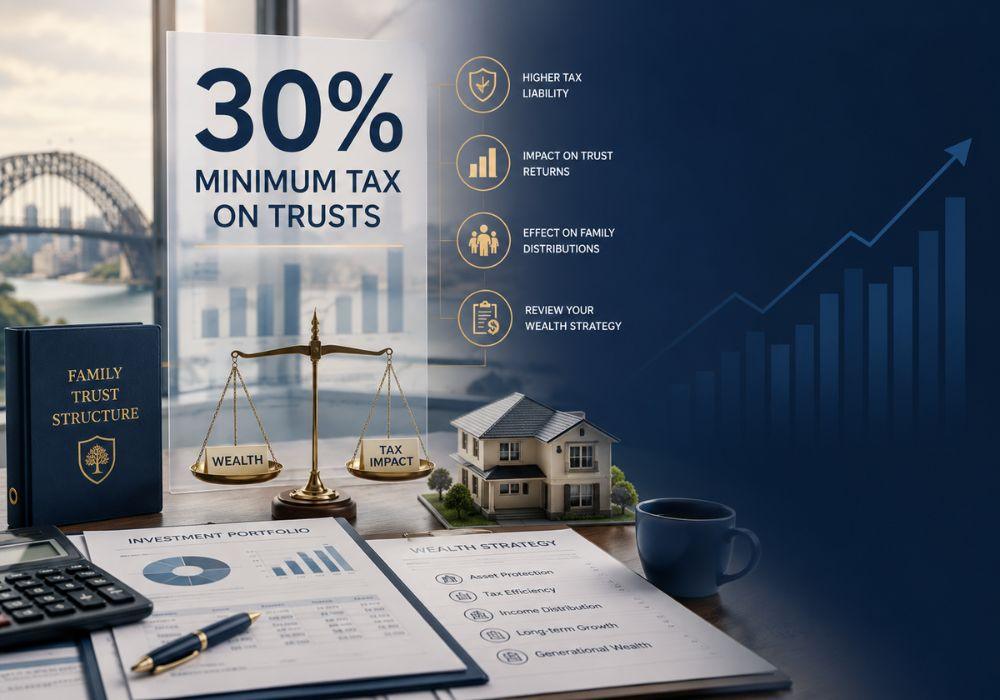
If you run a family business or hold investments through a discretionary trust, the 2026-27 Federal Budget has changes you need to understand before they land.
From 1 July 2028, the Australian Government is introducing a 30% minimum tax on discretionary trusts. This is not a minor adjustment. It directly targets income splitting, which has been the primary reason many families and small business owners have used discretionary trusts in the first place.
Here is what changes, who it affects, and what to consider now.
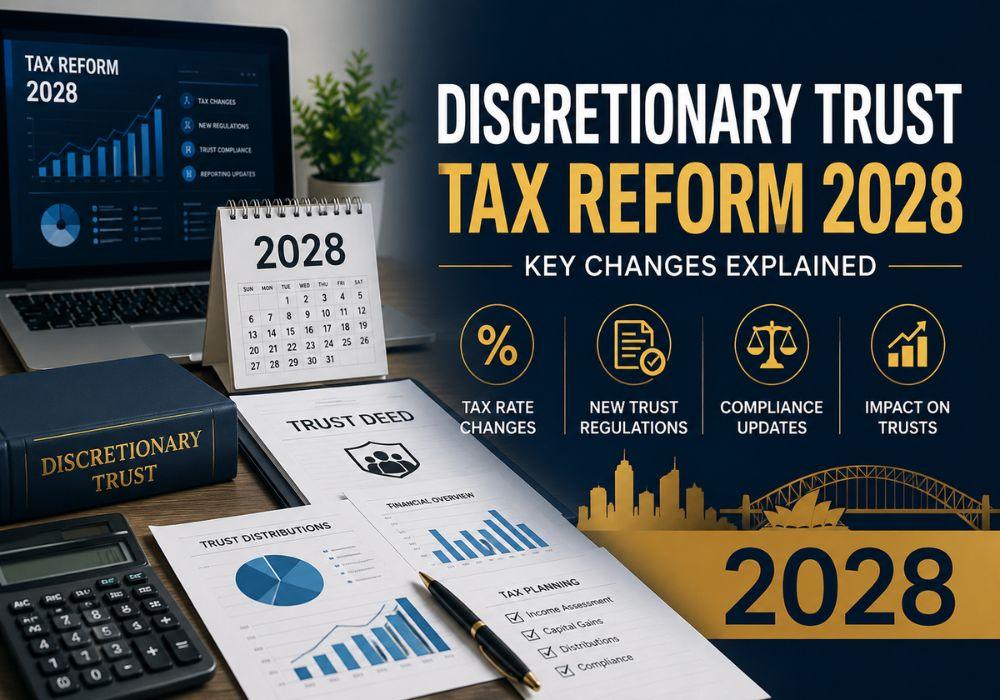
Why the Government Is Targeting Discretionary Trusts
In 2022-23, discretionary trusts distributed $142.4 billion in income to other entities. The Government’s own analysis shows that families with discretionary trusts paid an average tax rate around 4 percentage points lower than families on similar incomes who did not use a trust.
A trustee can choose to distribute income to family members at lower marginal rates, reducing the overall tax burden. Workers who pay tax on wages at marginal rates do not have that option.
Numerous Australian tax reviews have raised this concern for decades, including the Asprey Report (1975), the Review of Business Taxation (1999), the Australia’s Future Tax System review (2009), and the Re:think review (2015).
The 2026-27 Budget is the first time a government has moved to legislate a structural fix. The measure is estimated to raise $4.5 billion over five years from 2025-26.
How the 30 Per Cent Minimum Tax Works
From 1 July 2028, the trustee of a discretionary trust pays 30% tax on the trust’s taxable income. This operates as a minimum rate. If a beneficiary’s marginal rate is already above 30%, they pay top-up tax on top of the credits received.
Non-corporate beneficiaries still include their trust distributions in their own tax returns. They receive non-refundable tax credits for the tax paid by the trustee, which offsets their personal income tax liability. Non-refundable means that if a beneficiary’s marginal rate is lower than 30%, they do not get a refund of the difference.
Previously, splitting $200,000 of trust income across four family members with no other income meant a combined tax bill of around $24,008, an average rate of about 12%. Under the minimum tax, that same $200,000 attracts 30% tax at trustee level, bringing the outcome much closer to what a salaried worker on the same income would pay.
Broadly, individual beneficiaries on taxable income below $45,000 before the distribution are most exposed, since the non-refundability of the credit means more total tax is paid than under current rules.
Corporate Beneficiaries and the Bucket Company Problem
Many trust structures use a corporate beneficiary, often called a bucket company, to park income at the corporate tax rate and build up retained earnings. The new rules close this off.
This measure was announced in the 2026-27 Federal Budget but is not yet law. Details below reflect the Government’s stated policy as at budget night. Legislation is expected to be introduced by end of 2026. Seek professional advice as the details are finalised.
Corporate beneficiaries will not receive credits for the tax paid by the trustee. This means the minimum tax cannot be avoided by cycling income through a company. According to the Government’s data, of the 80,000 companies receiving distributions from discretionary trusts in 2022-23, 83% showed no evidence of business activity.
The practical impact is significant. Indicative modelling from Pitcher Partners suggests distributions to a corporate beneficiary could face an effective tax rate of around 51% at the company level, rising to approximately 62.9% when that income is eventually distributed to individual shareholders. This is expected to be a key focus during stakeholder consultation before legislation is finalised.
What This Means for Small Businesses
The Government’s own modelling shows a small business earning $300,000 through a discretionary trust would, once the minimum tax applies, pay more tax overall than an equivalent business structured as a company.
In the Government’s example, the company structure results in $72,002 in total tax paid, compared to $86,002 under the trust with the minimum tax in place.
One practical option the Government has flagged: small businesses can reduce the impact of the minimum tax by paying working family members a salary or wage rather than a trust distribution. Wage payments are not subject to the minimum tax.
The Restructure Window
The Government is giving trust holders time to restructure before the minimum tax starts. Expanded rollover relief is available from 1 July 2027 to 30 June 2030, covering both capital gains tax and income tax consequences for those who move out of a discretionary trust.
This means you can restructure into a company or fixed trust during this window without triggering a CGT event on the transfer of assets. That is a meaningful concession, and it is time-limited.
From 1 January 2027, the Australian Small Business and Family Enterprise Ombudsman will be available to help small businesses understand their options and get advice on restructuring.
Small businesses restructuring into a company may benefit from the 25% small business corporate tax rate, provided annual aggregated turnover is under $50 million and no more than 80% of assessable income is passive. Companies also offer simpler ways to retain earnings and access debt financing.
A Comparison with Key Changes
Scenario | Before 1 July 2028 | After 1 July 2028 |
Family trust distributes $200K to 4 low-income members | Tax approx. $24,008 (~12% average) | Trust pays 30% on $200K; members receive non-refundable credits |
Income distributed to a bucket company | Company pays 25-30% corporate rate; credits flow through | No credits to corporate beneficiary; effective rate potentially 51-62.9% |
Income distributed to beneficiaries already on 30%+ rate | Existing marginal rates apply | No change; minimum tax already met |
Fixed trust or complying super fund | Existing rules apply | Excluded; existing rules continue |
Who Is Excluded from the Minimum Tax
Not all trusts are caught. The 30% minimum tax does not apply to:
- Fixed trusts
- Widely-held trusts
- Complying superannuation funds
- Special disability trusts
- Deceased estates
- Charitable trusts
Certain types of income are also excluded, including primary production income, income relating to vulnerable minors, amounts subject to non-resident withholding tax, and income from assets of discretionary testamentary trusts that were in existence on 12 May 2026 (the announcement date).
If you are a farmer holding agricultural land in a discretionary trust, or you have a discretionary testamentary trust that was already in existence on 12 May 2026, the rules are different for you. Get specific advice rather than assuming you are in or out.
It is also worth noting that new discretionary testamentary trusts (those not in existence by 12 May 2026) are not grandfathered, meaning minors who receive distributions from such trusts may also be affected.
Related Articles: